Why do conversations about AI in education often seem to miss each other?
One reason is that we’re often speaking from different philosophical lenses without realizing it.
Over the past few months, I’ve been working on a manuscript exploring postphenomenology and AI in education. Along the way, I’ve been reading across several philosophical traditions that continue to shape how researchers think about AI and human-technology relationships.
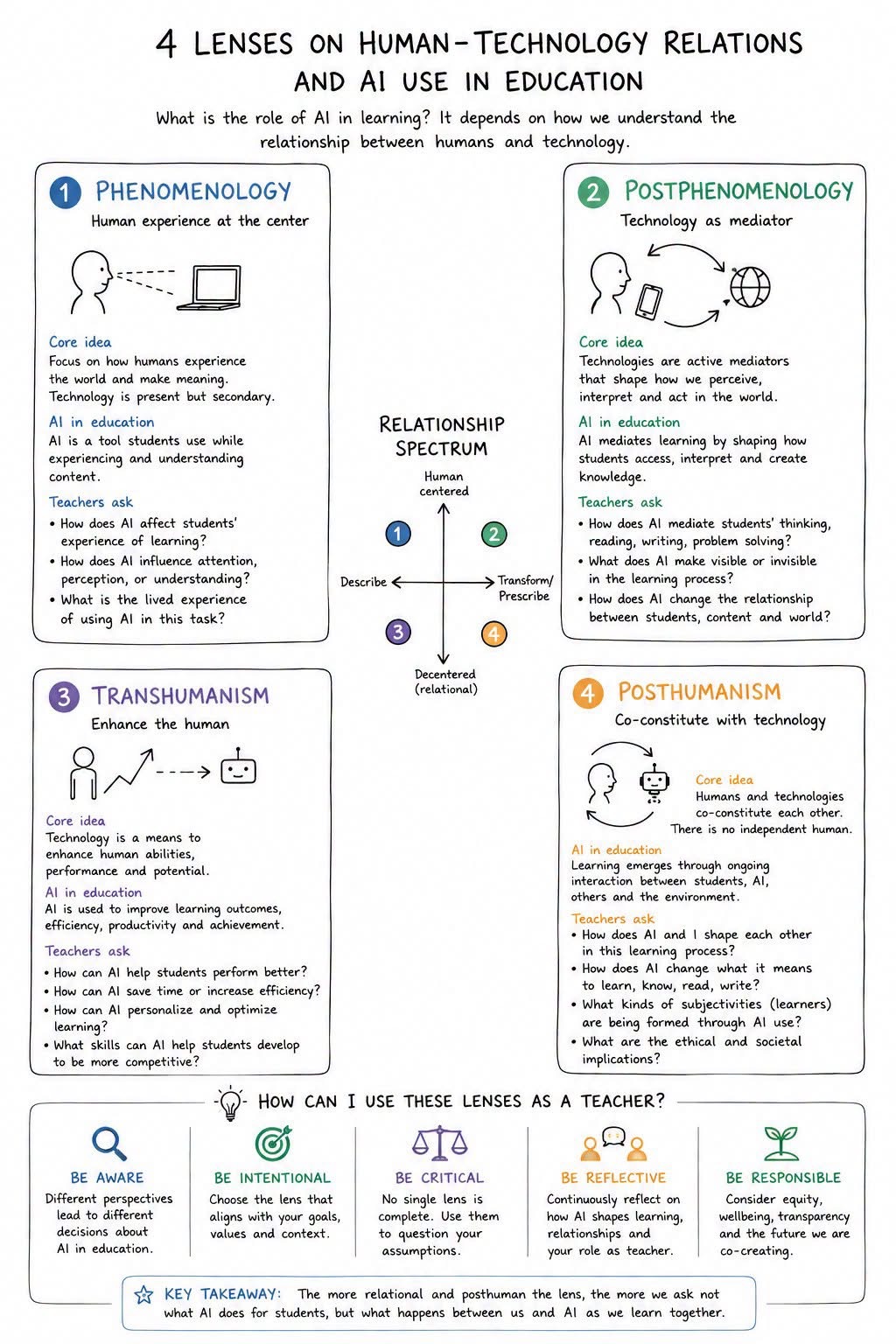
I thought it would be helpful to bring these ideas together in a simple visual. The four key perspectives are:
- Phenomenology: How humans experience the world
- Postphenomenology: How technologies mediate human experience
- Transhumanism: How technology can enhance human capabilities
- Posthumanism: How humans and technologies co-constitute one another
You certainly don’t need to become a philosopher to teach with AI. But having a basic understanding of these perspectives can make a real difference.
They influence the kinds of questions we ask.
Instead of asking only “How can AI help students learn faster?”, we may also ask:
How is AI changing students’ reading and writing practices?
What kinds of thinking does AI encourage—or discourage?
How does AI reshape the relationship between learners, knowledge, and teachers?
What kinds of learners are we helping to form?
In other words, our assumptions about AI often determine the questions we ask, the classroom activities we design, and even what we consider successful learning.
The infographic summarizes these four perspectives, explains how each views AI in education, and includes example questions teachers can ask when planning AI-supported learning.
The ideas in the visual draw on work by several influential scholars, including:
Honneth, A. (1995). The struggle for recognition: The moral grammar of social conflicts (J. Anderson, Trans.). MIT Press.
Root, D. (2025). Reconfiguring the alterity relation: The role of communication in interactions with social robots and chatbots. AI & Society, 40, 1321–1332.
Verbeek, P.-P. (2005). What things do: Philosophical reflections on technology, agency, and design (R. P. Crease, Trans.). Pennsylvania State University Press.
Verbeek, P.-P. (2008). Cyborg intentionality: Rethinking the phenomenology of human–technology relations. Phenomenology and the Cognitive Sciences, 7(3), 387–395.
#AI #ArtificialIntelligence #Education #EducationalTechnology #Teachers #EdTech #AIinEducation #Postphenomenology #Posthumanism #Transhumanism #Phenomenology #Learning #Teaching #DigitalPedagogy #HigherEducation
Written by Med Kharbach, PhD